



Manifesting Thunder Beings: The Convergence of Archaeology and Ethnography in Assiniboine Masks from the North American Great Plains
Manifestación de los Seres del Trueno: convergencia entre arqueología y etnografía en las máscaras assiniboine de las Grandes Llanuras de Norteamérica


Some historical Northern Plains Indigenous masks feature designs that display formal resemblances with those found on rock art and on objects made of shell that were traded over large parts of North America during the pre-Columbian period. This article argues that these similarities are unlikely to be coincidental. It examines evidence for the longevity of beliefs associated with pre-Columbian imagery by drawing on repertoires of oral tradition that continued to play a significant role in rites and ceremonies in which ethnographically recorded masks had a central function. Addressing the role of material culture in Native North American societies, the article draws attention to a typology of ritual objects that has not yet received adequate scholarly attention. It argues that these objects should be understood as part of Indigenous North American practices of transformation, based on ideas of inter-species relationships and communication with other-than-human beings, rooted in past iconographies and religious ideologies.
Keywords: Native North American art, masks and masking, manifestation, agency, ritual objects, performativity, ontology.
INTRODUCTION
In a paper published in 1909, anthropologist Robert Lowie gave an account of masking practices among the Assiniboine (or Nakoda), a historical Siouan-language group from the northwestern Great Plains of North America (fig. 1).

Figure 1. North America’s Great Plains with Assiniboine territories highlighted. Figura 1. Las Grandes Llanuras de Norteamérica, con el territorio assiniboine demarcado.
The masks he recorded were used in the context of dramatic public pageants common across the region during which certain people displayed their ability to heal, divine, and perform astonishing feats such as shape-shifting. The report features four images of the masks, which variably display marks around the eyes and across the cheeks, a detail that Lowie does not explain but that suggests a less than a coincidental reoccurrence in a variety of expressive forms recorded over time throughout the area (Lowie 1909: 65-66, figs. 15 and 17) (figs. 2 and 3).
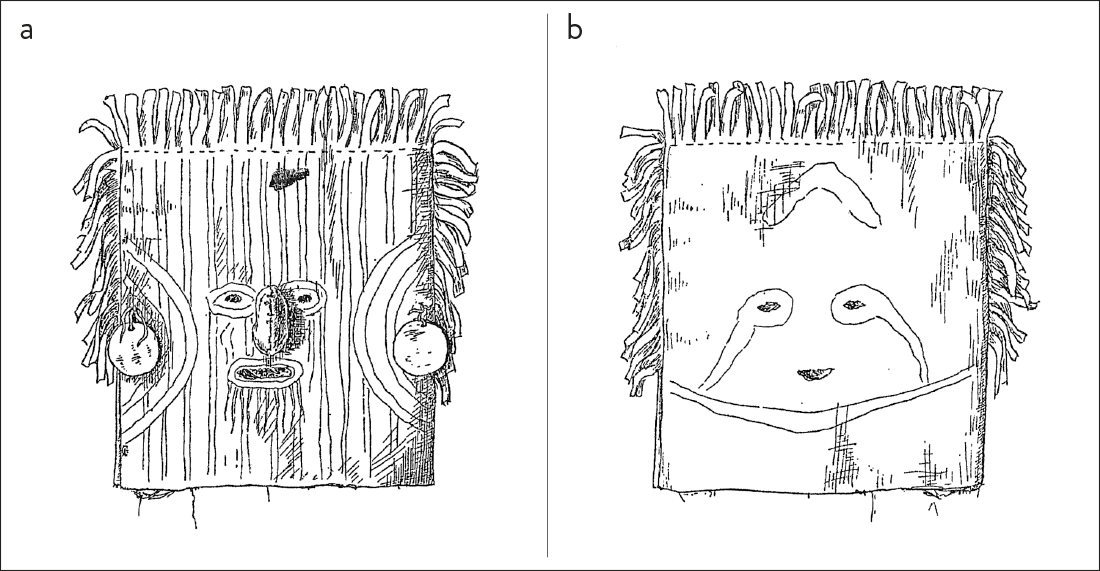
Figure 2. Assiniboine Fool-Dance mask N° 50-7112, American Museum of Natural History (amnh), New York: a) front view; b) back view; length 43 cm (modified from Lowie [1909: 65, fi g. 15]). Figura 2. Máscara de la Danza del Loco assiniboine N° 50-7112, American Museum of Natural History (amnh), Nueva York: a) vista frontal; b) vista posterior; largo 43 cm (modificada desde Lowie [1909: 65, fig. 15]).
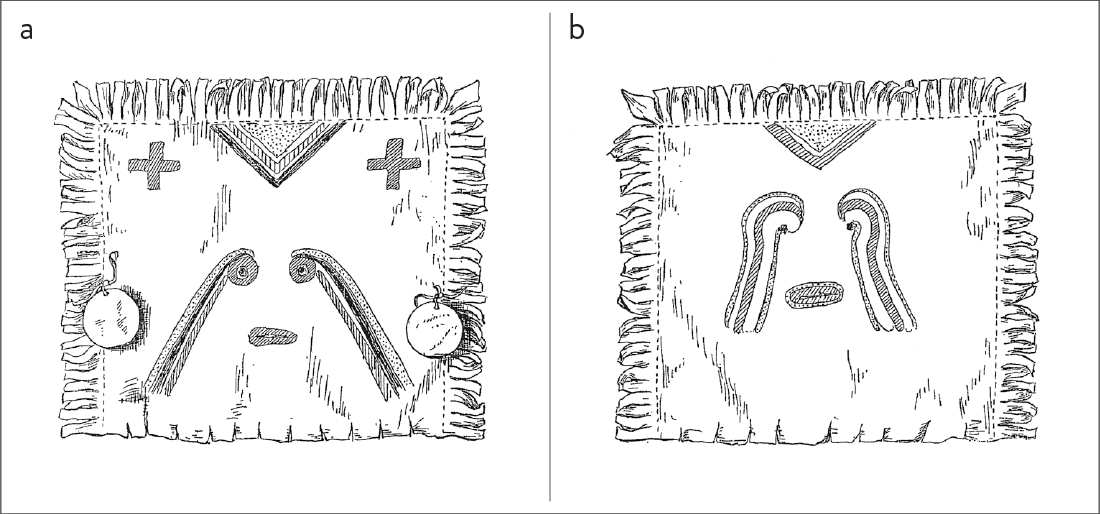
Figure 3. Assiniboine Fool-Dance mask N° 50-7114, amnh, New York: a) front view; b) back view; length 45 cm (modified from Lowie [1909: 66, figs. 16-17]). Figura 3. Máscara de la Danza del Loco assiniboine N° 50-7114, amnh, Nueva York: a) vista frontal; b) vista posterior; largo 45 cm (modificada desde Lowie [1909: 66, figs.16-17]).
These masks’ designs bear substantial similarities to ancient depictions of sacred thunder beings, also known as Thunderers, and associated figures such as the Hero Twins. They are carved on shells from the Mississippian period (ca. ad 1000-1650) found in Manitoba, Saskatchewan, and North Dakota, and also etched on rock surfaces across the northern Plains (Syms 1979: 291, fig. 6; Brain & Phillips 1996; Díaz-Granados et al. 2001: 485, fig. 3; Schneider 2003: 160-161, 163, figs. A77, A78, A81; Sundstrom 2015: 170, fig. 13.12; Dye 2023: 113, fig. 7.1) (fig. 4).
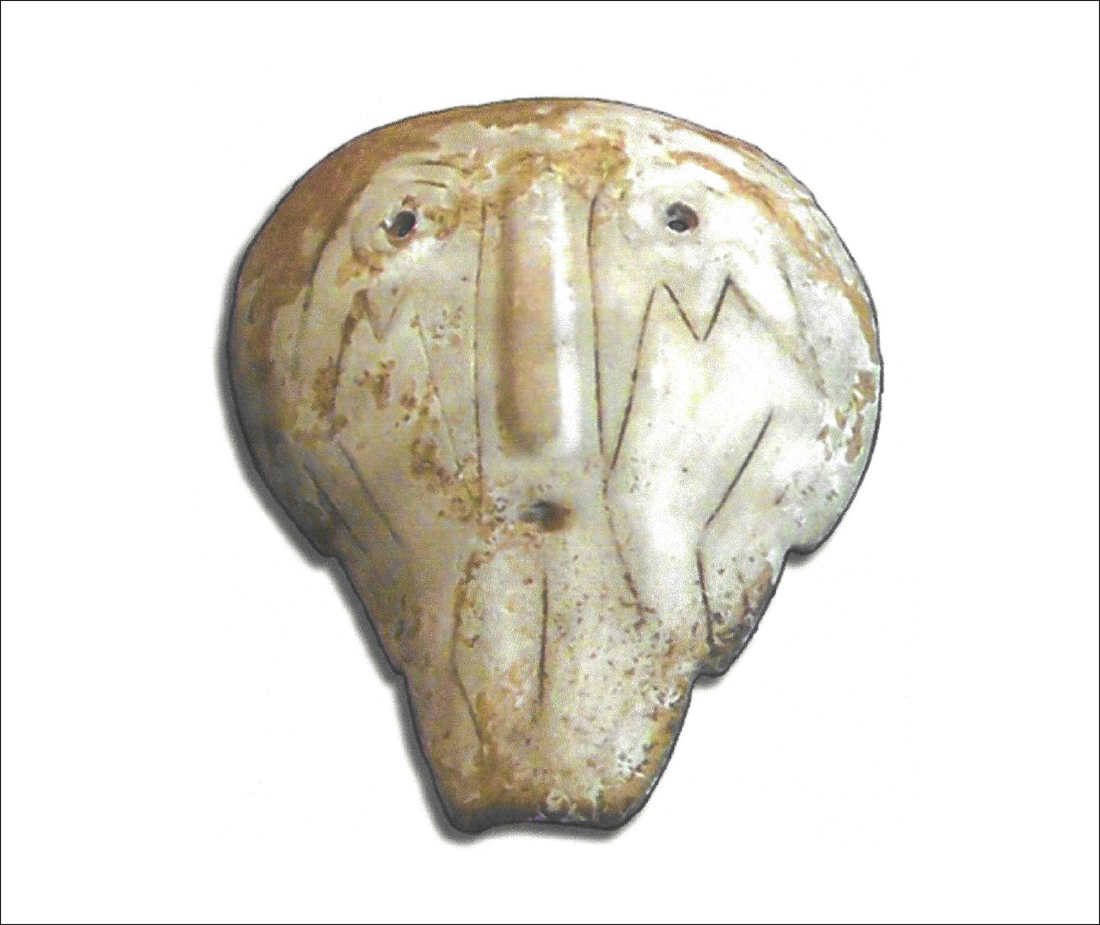
Figure 4. Late Mississippian Buffalo style shell mask, Barton Ranch, Arkansas, ca. ad 1550-1625; length 14.5 cm, width 8.6 cm. Hampson Archaeological Museum State Park, ID: BR_1503 (photo by Herb Roe [2012]). Figura 4. Máscara de concha de estilo Búfalo del período Mississippi Tardío, ca. 1550-1625 dc; largo 14,5 cm; ancho 8,6 cm. Hampson Archaeological Museum State Park, ID: BR_1503 (fotografía de Herb Roe [2012]).
Specialized literature calls the motif that characterizes these entities the “forked” or “weeping eye” (henceforth forked/weeping eye) (Hall 1977). Possible correlations between ethnographic masks and pre-Columbian iconography invite an examination of design persistence over time that interrogates the reasons why they appear on objects separated by culture and time; a question that involves asking who exactly the masks identified. Here I maintain that the designs featured on the Assiniboine society masks at the center of this investigation are results of semiotic continuity rooted in animistic ontologies of great antiquity, and that meanings associated with them confirm their identity as beings related to the mighty Thunderers.
The following examination aligns with a body of literature that treats Native North American masks as objects endowed with agentive and transformative powers (Gill 1976; Sekaquaptewa 1976; Sundstrom 2015). Indigenous ways of knowing and thinking about history and reality have been essential to craft the present interpretation of their cultures, which are based on epistemological and ontological premises that challenge earlier ethnographers’ positivist assumptions (Buffalohead 2004; Duarte & Belarde-Lewis 2015; Roulette 2021 in Matthews et al. 2021).
Based on these premises, it is tempting to hypothesize that the Assiniboine masks described by Lowie (1909) were more than representations of beings impersonated by performers as some literature suggested for other North American contexts (Densmore 1947; Monaco 1977; Oosten 1992). By contrast, they could be understood as manifestations of their presence among humans in line with new theories of material culture in which objects are not representations of belief, but co-constitutive agents within relational worlds in which they actively participate (Alberti et al. 2011; Watts 2013; Harrison-Buck & Hendon 2018; Qu 2020; Matthews et al. 2021; Janssons 2022).
To sustain this argument, I will make an analytical distinction between representation and manifestation that emerges from my reading of Native North American ethnography, starting from the work of Paul Radin and Irwing Hallowell whose Indigenous informants reported the distinction between inert and active in language and practice. Their studies revealed that in Indigenous thought what external observers would call objects, under certain circumstances can be agents, or “other-than-human persons” (Radin 1914; Hallowell 1960). After them a host of Indigenous and non-Native scholars and cultural consultants have proven ritual and ceremonial objects’ agentive and intentional qualities that challenge the notion of masks as representations, as will be explained later (Dorsey 1903: 20-21; Wissler 1912a: 103; Ewers 1981: 264; Hungry-Wolf 1982; Schlesier 1993: 17, fig. 2; Ridington & Hastings 1997; Zedeño 2008; Peers & Brown 2015; Matthews 2016; Matthews et al. 2021). Sam Gill (1977: 458) talking about Hopi masks elaborated on the distinction between inanimate and active agents by noting that “material […] without the spiritual is […] a work of art”, a sentence that when paraphrased simply means inert representation. This notion is relevant to Assiniboine masks because it underscores the participation of objects endowed with intentionality and personhood in the world of humans. It is a foundational axiom, shared among most Native American and other animistic societies, central for rethinking masks as kinds of object-agents that act and affect phenomenal reality through the symbols that carry different powers (Gill 1977; Gell 1992; Viveiros de Castro 1998; Conneller 2004; Latour 2005; Harvey 2006, 2017; Holbraad 2007; Mills & Ferguson 2008; Elliott & Conneller 2020; Qu 2020; Wallis & Carocci 2021).
Scholarship on Native American art is embracing this idea to interpret how animistic ontologies have been shaping stylistic choices in material and visual culture since pre-Columbian times (VanPool & Newsome 2012; Pauketat 2013; Wallis 2013; Carmody & Barrier 2020; VanPool & VanPool 2021; Carocci 2023). The consistent reappearance of designs such as the forked/weeping eye at different historical points in various parts of North America signals the power of specific symbols and themes associated with ancient motifs, which survived into the historic period despite changes and ruptures (Hall 1997; Brown 2007). Demonstrable analogies between oral traditions and archaeological material not only indicate longevity of specific iconographies, but the resilience of old epistemological and ontological principles that structured Native belief and practice over time, which ultimately can explain ethnographic masks’ efficacy (Irwin 1994; Pauketat 2013).
Anthropologist Eduardo Viveiros de Castro’s reflection (1998: 478) on the relationship between interiority and exteriority of human and other bodies among Amazonian peoples is particularly central to the present re-evaluation of Northern Plains masks’ ontological status. For many Native North Americans too adopting another being’s exteriority enables a person to partake of “affects, dispositions, and capacities” unique to it. Despite substantial geographical distance, the ontological principles elaborated by Viveiros de Castro resonate with how the Indigenous societies examined here understood ideas of essence and presence. In the Amazon, adopting someone else’s body allows one to act from the perspective afforded by it. Similarly, among North American peoples assuming someone’s outer appearances gives direct access to the ways of being associated with that body. Masks like bodies, Viveiro de Castro (1998: 482) further argues, allow wearers to access the powers of the beings they depict because by taking their outer appearances announced by the signs that define them, wearers can act like them.
Viveiros de Castro’s suggestion that masks facilitate a process of transformation that manifest the beings depicted through the adoption of their attributes is reflected in several Native American masked events. In these contexts, similarity between the object and the referent results in ontological change (Gill 1976; Sekaquaptewa 1976; Neil 1986; Seip 1999; Clark 2013; Sundstrom 2015). The ritual function of the Northern Plains masks constructed them as a particular type of object-actant that established a direct relationship between beings, even if they existed in different registers of reality (Latour 2005).
Testing the hypothesis that Indigenous Northern Plains masks are simultaneously the entities they represent and their depictions will benefit from the input of Charles Sanders Peirce’s semiotics (Peirce 1955), which allows various modes of symbolization to co-exist (Pollock 1995; Wallis 2013). Peircean semiotics’ tripartite division into symbols, icons, and indexes, is here helpful in explaining how Northern Plains Indian masks variably operated in different symbolic modes, and at times, simultaneously. In the model proposed by Peirce, a symbol is a conventional sign that has no immediate or direct relationship to the object it is supposed to represent. An icon is a sign that bears resemblance to its object, and an index reveals a correspondence of fact between the sign and the referent through causality or proximity (Mertz 2007; Harris & Cipolla 2017). This positions objects as indexes at the centre of social relationships, thus recovering symbolization processes’ relational aspects central to animistic modes of interaction between humans and other actants operating in Native North America since at least the Mississippian times (ca. ad 800/1000-1650) (Baires & Baltus 2020). Peircean semiotics can help us understand how transformation can take place in the case of masks. By adopting the signs that indicate the invisible presence of incorporeal beings such as the Thunderers, humans take on their appearances following the animistic logic expounded by Viveiros de Castro (1998) and repeatedly recorded in other Indigenous American contexts.
Indexing incorporeal beings by producing effigies, images, and depictions that resemble their appearances has been widely documented among North America’s pre-Columbian cultures. Scholars have analyzed these ancient iconographies considering the ethnographic evidence provided by the most direct likely descendants of the archaeological cultures that produced them (Buffalohead 2004; Reilly & Garber 2007; Lankford et al. 2011). Arguments that support possible correlations between old motifs and ethnographic specimens can be found in the reoccurrence of certain themes in mythological and cosmological repertoires that cross linguistic boundaries. Though tracing direct links between present and past may be possible only in some cases, it is still feasible to suggest that the cross-cultural frequency and resilience of certain themes may result from their value in social reproduction and ritual efficacy. Borrowings, re-elaborations, and local variations of certain designs may explain regional and even temporal adaptations without compromising the emotive and effective power retained by tenacious religious symbols and tropes.
In what follows I examine elements of pre-Columbian iconography relevant to the analysis to explain continuity with mask specimens recorded by early twentieth century anthropologists. I then review the ethnographic evidence to elaborate some conclusions and reflections.
HISTORICAL BACKGROUND
Establishing the antiquity of masking practices for the North American Plains poses a series of challenges given the cultural variations that characterized the region from Paleo-Indian period (ca. 15,000- 8000 bc) to the first millennium of the current era (Gibbon 1988; Schlesier 1994; Fowler 2003). The earliest depictions of masks and/or faces appear around the 15th century ad in the south and eastern regions (Arkansas, Oklahoma) (Brown 1996). For later periods, additional evidence comes from the rock art of the Rocky Mountains in Montana (Keyser & Sundstrom 2015; Sundstrom 2015), Saskatchewan (Schneider 2003), and the Black Hills in South Dakota (Sundstrom 2004). In these latter regions, theriantropic imagery and frontally depicted faces may suggest mask use (Keiser & Klassen 2001; Sundstrom 2004) (fig. 5).
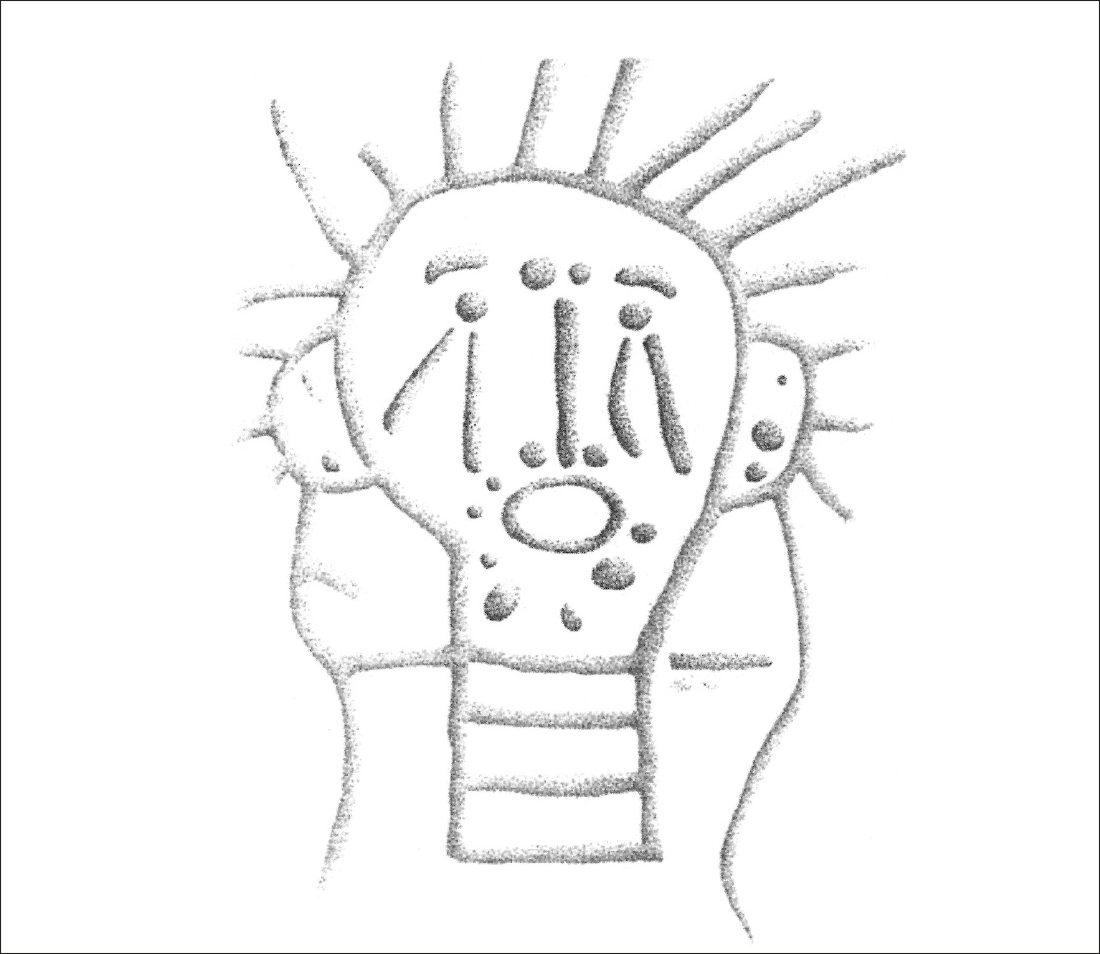
Figure 5. Face carved into boulder, artist reproduction of the Weyburn Petroglyph, Saskatchewan (illustration by Erynn Dyle Schnieder, modified from Schneider [2003: 163, fig. A81], used with permission of the Archaeology Department of the University of Saskatchewan, Saskatchewan, Canada). Figura 5. Rostro tallado en roca, reproducción artística del petroglifo Weyburn, Saskatchewan (ilustración de Erynn Dyle Schneider, modificada desde Schneider [2003:163, fig. A81], con permiso del Archaeology Department de la University of Saskatchewan, Saskatchewan, Canadá).
Unfortunately, gaps in the archaeological record cannot confirm with material evidence what rock art depicts for these early periods. It is nonetheless possible that natural pigments may have been used to paint the face instead of masking to perform the same function. This practice may have substituted the use of masks in the past, given the special power awarded to coloring matter in ritual and bundling (Wissler 1907: 42-43; Zedeño 2008). Additionally, the use of perishable materials that may have been employed to make masks could be another reason why, so far, no physical object related to the practice has been recovered from controlled excavations in the Northern Plains.
Images that suggest masked or transforming humans depict what appear to be hybrid figures that display elk, deer, or buffalo heads on human bodies, which echo historical expressions and ethnographically-recorded masking practices in ritual and ceremonial contexts of the Mandan, Sioux, Cheyenne, Quapaw, Blackfoot and other northern groups (Horse Capture et al. 1993: 134-135; Taylor 1996; Feest 2007; Hansen 2007: 147; Byrd et al. 2025). To an external observer it is not always clear what images of faces found on rock art across the Plains represent. Stating with absolute certainty that these are visualization of masks requires caution. They may depict temporary alterations of the face with paint or announce the presence of a special being that inhabited the site, or both. Sometimes, streaked cheeks may be depictions of tears, ceremonial paint, or visualizations of power emitted by the eyes. Regardless of what we may see in these pictures, seeking a single explanation for what they may have represented for the makers may be futile because in ritual contexts distinctions between states of being collapsed into one ontological dimension. If indeed some of this imagery depicts transformative states through the use of masks there would be no substantial difference in depicting what observers may see (the mask worn by a human), and what their wearers may become (the entity that manifests itself through donning the mask); the mask and who it represents would be one and the same. If this hypothesis is right, rock art depictions of hybrid figures may simultaneously be depictions of masked individuals, representations of states of transformation, and visualizations of other-than-human persons inhabiting the site. In other words, it can be representation as well as an instance of images that act (Zwadzka 2021: 275).
Plains peoples believed in the transformational power of masks to turn beings into what they depicted (Berlo 2000; Sundstrom 2015). As such, visual records may simply convey the transformative process as experienced by the wearers, conventionally visualized through a synthesis of attributes that stood for different ontological registers: those that pertain to phenomenal reality and those that inhabit a metaphysical state coming together in the act of shape-shifting. Visually, this idea was conveyed by assembling human and other-than-human characteristics in therianthropic, or hybrid figures, as can be seen in rare Plains Cree images of Thunder beings painted on tipis (Skinner 1914a: 70-71, fig. 8).
This representational strategy is very old and widespread. It can be found in effigies produced since the Hopewell times (ad 100-500) outside the Plains area, yet they indicate the endurance of a notion that eventually became a repertoire of Indigenous cultures on both sides of the Mississippi (Squier & Davis 1973: 247, figs. 146-147). During the Mississippian period, composite beings convincingly synthesized the concept of a reality in which transformation is a real possibility (Maurer 1977: 194, fig. 259; Díaz-Granados et al. 2001: 488, fig. 5). By creating configurations that defy Western perceptual parameters limited by the language of naturalism and imagination, Plains Indigenous peoples and their predecessors appear to have made visually clear otherwise ungraspable realities and states of being that challenge Cartesian premises by blurring the boundaries between the material and the immaterial.
Although the antiquity of masking on the Northern Plains awaits further proof, it is possible to explain thematic continuities between ethnographically recorded masks, and mask-like objects traded into the Plains before the colonial period by way of oral traditions associated with specific beings and their iconographies (Smith & Smith 1989; Collins 1995). Among some of the most relevant thematic continuities relevant to the present interpretation of Northern Plains masks as instances of metaphysical manifestation are the incised whelk shells produced and exchanged in the context of the “Mississippian Ideological Interaction Sphere” (miis) (Reilly & Garber 2007; Duncan 2011; Butterfield 2018). With this definition it is possible to talk about cultural production, economic, and symbolic interactions informed by Mississippian cultures’ religious ideologies wherever their influence has been positively ascertained.
In miis regions, masks were utilized between 200 bp–ad 1650 years, during the Woodland, and subsequent Mississippian periods (Baby 1956; Collins & Farnsworth 1981; Brown 1996; Clark 2013). Although their ancient use is not clear and may not be immediately related to the employment of historic period masks in the Northern Plains, direct and/or mediated relationships between subsequent archaeological cultures reveal continuous and widespread distribution of shared oral traditions. Likewise, an extensive trade of objects decorated with iconographies so similar to those found on ethnographic specimens that comparisons has been considered legitimate (Skinner 1914b, 1914c; Griffin & Morse 1961; Collins & Farnsworth 1981; Brasser 1987; Smith & Smith 1989; Schlesier 1994; Duncan & Díaz-Granados 2000; Ritterbush 2002; Bailey 2004; Buffalohead 2004; Reilly 2004).
There is substantial evidence that Mississippian material culture and ideologies reached the Northern Plains during the Protohistoric period (ad 1500-1800). While some cultural repertoires might have been shared orally, material and visual culture contributed to the spread of religious ideas and iconographies including those related to the Thunderbird by way of cultures such as the Oneota who moved to the Black Hills from areas that correspond to today’s Iowa (Sundstrom 1990; Ritterbush & Logan 2000; Buffalohead 2004). Maskettes, engraved whelk shells, and even iconographic elements found on rock and mobiliary art confirm the reach of Mississippian ideologies, thematic clusters, and material culture in the Northern Plains (McCharles 1887; Howard 1953; Brasser 1987; Keyser & Klassen 2001; Sundstrom 2004).
Thunderbirds, Hero Twins, and the forked/weeping eye motif make up a tightly integrated thematic cluster that had a widespread cultural impact on both pre-Columbian and historical societies. It is not only evident through iconographic consistency, but also through the historical resilience of similar motifs in myths and stories (Benn 1989; Berres 2001; Reilly & Garber 2007; Townsend & Sharp 2004; Lankford et al. 2011). Mississippian cultural heritage partially contributed to the development of historic peoples’ religious life, and on social organization based on sodalities, ceremonial groups, and dance associations established by dreamers who encountered specific beings, among which the Thunderers (Irwin 1994; Dye 2017, 2020). Exchange networks, ceremonial gifting, marriage, trade and alliances provided access to new ideas and iconographies that were acquired and eventually reworked in local versions of common themes (Fletcher & La Flesche 1911; Blakeslee 1981; Bailey 1995; Collins 1995; Hall 1997; Brasser 1999; Berres 2001: 190; Buffalohead 2004; Deter-Wolf & Díaz-Granados 2013).
Stylistically, certain designs associated with powerful figures proved to be extremely resistant to change. Motifs such as the forked/weeping eye associated with the thunder beings and the powerful Hero Twins are a case in point. During the Mississippian period these other-than-human beings were immortalized in art as central characters of origin stories, charter myths and epic cycles, which were still retold in historic times (Hall 1997). Oral traditions recovered in the 19th century report of Hero Twins that due to their upbringing are one civilized and one wild. The latter shows his un-socialized state by behaving against established norms (Duncan & Díaz-Granados 2000; Dye 2023). Embodying the eternal cosmic battle between opposites, the Hero Twins manifest the complementary sides of power, one creative and one destructive.
In addition to being phenomenal warriors and hunters, the Hero Twins also had the power to revive the dead, and by default, healing. Several shell masks with the marks of the Thunderers have been found on the Northern Plains, in areas directly linked to historical Plains peoples, and in some cases, they were included in war-related bundles and ceremonialism until recently (Dorsey 1885, 1972 [1894]; Howard 1953, 1956; Syms 1979; Ewers 1986: 133, fig 120; Smith & Smith 1989: 16; Collins 1995). These are what archaeologist, María Nieves Zedeño (2008, 2009) calls index objects that transfer power by way of contiguity. Though probably not used on the face, these shell masks were related to one of the Hero Twins’ martial characters, an important feature associated with historical warrior societies (Howard 1956; Mails 1973; Rice 1985; Berlo 1996; Powell 2002; Carocci 2012; Dye 2023).
The remarkable historical depth of these beliefs and practices show that religious ideologies centred around the Thunderers were underpinned by the notion that objects associated with them were inherently powerful. This was clearly visualized in images and representations of faces and hybrid other-than-human persons, which could transmit their power to handlers by proximity. Abilities received by any of these beings were brought into action into different spheres of social activity by means of objects that bore the signs of their identity as Thunderers, most significantly: the martial and the religious realms equally presided, at least in part, by them. It is in this latter context that some masks became more associated with well-being, abundance and healing guaranteed by masked dancers described by ethnographers between the late part of the nineteenth and early of the twentieth century to which we now turn.
ETHNOGRAPHIC EVIDENCE
Reports compiled by anthropologists at the beginning of the twentieth century reveal a widespread and sustained use of masks among Plains peoples. The practice was common among groups that that inhabit the Canada grasslands: Alberta, Saskatchewan, Manitoba, and Western Ontario. The Northern regions of the American plains and parts of the Midwest are here described as “Northern Plains” (Lowie 1909, 1913a, 1913b, 1983; Wissler 1912b; Skinner 1914b, 1914c; Kroeber & Holt 1920; Ray 1945; Howard 1954; Lewis 1974, 1982a, 1982b; Taylor 1996).
This literature discusses Indigenous Northern Plains masks in the context of sodalities whose members shared the same metaphysical experiences, most significantly dreams, apparitions, and visions of specific beings and/or animals. These became the patrons of the society, who instructed the dreamers to follow specific ritual, behavioral, and social obligations. Early reports can help contextualize mask use among the Northern Plains peoples in ritual complexes in which clowning behaviour converge with healing (Skinner 1914b: 501; 1914c: 529; 1915: 789; Ray 1945).
Ethnographic observations frequently describe clowning among the defining traits of Northern Plains masking practices, which are often linked to “contrary behaviour” (Kroeber & Holt 1920). This was a socially-sanctioned mode of interaction that required inverted speech and actions after encountering Thunder itself, the Hero Twins as Thunderers (Skinner 1914c: 528-529; Ray 1945: 105-108; Howard 1954: 254; Lewis 1974: 18, 1982a: 249; Dye 2023), or other incorporeal entities such as the Algonquian skeleton Pägûk (Lowie 1909: 65-70; Skinner 1914a: 500-505).
Masked rituals’ comedic aspect derived from antisocial, unnatural, unconventional, and extraordinary behavior, for example: cannibalism, consuming raw or scalding foods, or unbridled sexual appetite. This was implied in the names of several of the masked clubs such as the Assiniboine “fool dancers” and the Lakota Heyoka “clowns”. In several Indigenous North American languages’ eccentric behaviours were often defined with terms that in Indo-European languages could roughly translate as ‘crazy’, a term that may include all the connotation on the spectrum from foolish to possessed, enraptured, spirited, or frenzied. The literature about clowns and their spiritually informed contrary behaviours consistently stresses that their encounters with incorporeal beings turned them into what anthropological literature have called ‘sacred’ figures. Fittingly, Reverend James Dorsey (1972 [1894]: 469) reported that among nineteenth century Dakota Heyoka “the more absurd a thing is, the more ‘wakan’” (in the Dakota language: ‘awesome’, ‘inexplicable’, ‘sacred’, or ‘numinous’ [Powers 1977: 45-47]).(1) This correlation clearly suggests that society members’ humoristic antics were underpinned by a religious substratum whose very existence was predicated upon the presence of sacred entities such as the Thunderers.
The Assiniboine masks described by Lowie fit within this context. Employed by members of the “Fool Dancers” society, variations of these ritual objects could at the time be found among other neighbouring Northern Plains groups such as Plains Cree, Plains Ojibwa, Crow, and Dakota. In most cases, they were square hoods made of commercial fabric variably decorated with stripes, crosses and chevrons on the forehead and across the face.(2) Occasionally they may be conical fabric hoods, to which nose or earrings were attached (Lowie 1913b: 207, 209-210, figs. 6 and 7; Howard 1954: 257; Lewis 1974: 20-21, 1982b: 893; Skinner 2014b: 500, 503, figs. 5 and 6). Not coincidentally, conical headdresses were also used in the Santee Contrary Society dances associated with the Thunderers (Eastman 1853). What is more, Lightning Boy one of the Hero Twins known across the Plains may appear with a cone-shaped head (Dye 2023).(3) Additionally, the phallic long noses featured on Northern Plains clowns’ masks may be further evidence of enduring themes associated with the Thunderers. The so-called “Long-nose” maskettes recovered in Plains archaeological contexts have distinctive sexual connotations confirmed in old oral traditions (Anderson 1975; Tiffany 2003). In one legend the taming of unbridled sexuality and final assimilation of the wild Hero Twins into cultured society is metaphorically achieved by the reduction of his nose (Duncan & Díaz-Granados 2000: 8).(4)
Among the Assiniboine and the Crow masks’ eye slits featured special marks that recall tears, the sign of crying for a vision, the precondition to alternative states of consciousness that allowed individual supplicants to connect and communicate with otherwise invisible beings (Lowie 1909: 65-66, figs. 15-17; Lowie 1913b: 209, fig. 6; Irwin 1994). Significantly, these weeping eyes also resembled the malar stripe of the hawk, a bird believed to be manifestation of Thunder beings whose eyes emitted lightning and the recognizable trademark of the Hero Twins (Salzer & Rajanovich 2001; Giles 2020; Carocci 2023).
Further proof of masked society members’ association with Thunder beings were the zigzagging lines painted on their arms and legs that indexed energy and thunder/lightning (Wissler 1907: 51; Berlo 2000: 29-30, pls. 1 and 2). They also carried sticks from which hung deer’s hoof rattles, an implement associated with the Thunderers and thunderclaps (Lowie 1909: 62; Skinner 1914b: 500; 1914c: 528; Green 1999). This indicated that societies such as the Fool Dancers (Assiniboine), the Wetigokanuk (Plains-Cree), and Windigokan (Plains-Ojibwa), performed healing rituals. Though not handling these implements, even Cheyenne men of the Hohnuk (contrary society) were said to behave like thunders in a storm, and doctored people by jumping on them (Grinnell 1972: vol. ii, 329). Healing was one of the Hero Twins’ abilities, which the society members received from the Thunderers themselves through visions and dreaming (Irwin 1994; Dye 2023). Most of them were obliged to use contrary speech also in their daily life, another feature reminiscent of the wild Hero Twins behaving against socially acceptable rules. The intimate connection between humans and Thunderers was further sealed by way of donning a mask that bore their marks. This allowed them to achieve a full transformation that enabled them to access the powers that these beings were endowed with.
Plains Indian oral traditions variably reflect on the role that exterior signs have in announcing a change of identity. Myths about humans turning into animals and vice versa reveal that adopting the outer skin of another being allows one to access their powers (Dorsey 1904a: 42; 1904b: 111-114; Radin 1914: 371; Lowie 1922: 326; Grinnell 1972: vol. ii, 108; Bowers 1992: 469; Pollock 1995; Parks 1996: 146; Willmott 2014). Adopting a new skin, like donning a mask, means becoming the receptacle that, by way of specific traits, indexes a different presence. The mask therefore is both an icon and an index at the same time, in so much as it resembles the being the human is changing into and concurrently announces its existence in the phenomenal world.
Christine and Todd VanPool’s (2021) work on Casas Grandes Mogollon remind us that, in parts of Native North America, the faithful depiction of certain beings on material supports ensured their presence in specially decorated objects. Iconographic correspondence between the being’s outer appearances and the human-made artistic depiction was essential for an intangible being to manifest itself, as it provided the appropriate vessel for its temporary corporeal existence. Similarly, among Northern Plains peoples, specific symbols on masks, not only revealed that a change of status was taking place, but it signalled who the being was. This is evident in the adoption of lines descending from the eyes, which revealed that performers turned into Thunderers, or acquired their powers by adopting their social skin (Turner 1980; Pollock 1995; Viveiros de Castro 1998; Qu 2020).
No clearer understanding of this transformative process are the illustrations made by the Lakota Black Hawk (1832-1890) (Berlo 2000). In a set of drawings depicting animal dances, he shows trans-species transformation by way of masks. Buffalo, deer, antelope, and other dancers donning masks of these beings during dedicated rituals are depicted as composite figures with human and animal features, for example, one human foot and one hoof, or that are leaving traces as animal tracks (Berlo 2000: 44-64, figs. 10-17). His drawings resonate with earlier rock-art imagery showing human-animal hybrids and other theriantoropic beings discussed above (Squier & Davis 1973: 247, figs. 146 and 147; Maurer 1977: 194, fig. 259; Díaz-Granados et al. 2001: 487-488, figs. 4 and 5; Feest 2007: 121). From these images, we can deduce that a process of transformation is set off by the intercession of objects bearing the marks that evoke, and at the same time, resemble the feature of the beings that humans want to turn into. The Northern Plains Indian ceremonial masks are among those objects. They manifest what is normally invisible to the human eye. They may transmit to humans special powers such as healing, which set them apart from other forms of material or visual expressions not endowed with such potential.
Because Northern Plains Indian masks contain the essence of specific beings, they cannot be considered simple representations. Once worn, masks affected phenomenal reality, they allowed the wearer to bless, cure, and heal because they embodied the characters associated with these abilities. By contrast drawings, especially those made in post-contact times for documentary function, only had the effect of explaining and recording facts, like in the case of Black Hawk’s visualization of performances and dances with crayons on paper, or the buffalo dancers painted on an eighteenth century Quapaw painted robe recently exhibited in Paris (Byrd et al. 2025). These images are in stark contrast with rock art depictions that, as it has been demonstrated, had a similar function to masks: to evoke or manifest the presence of intangible beings (Sundstrom 2004: 45-46).
CONCLUSIONS
A comparison of a group of Native North American ceremonial masks ethnographically described in the early twentieth century with pre-Columbian iconographies and oral accounts of remote mythical beings revealed symbolic continuities with designs and ontologies that have their roots in the ancient past. Combining ontological theory with Indigenous animisms provided a useful framework to understand how masks operated in the ceremonial world of Indigenous groups such as the Assiniboine at the center of this investigation.
Focussing on the masks’ forked/weeping eye motif that identifies masked dancers as men transformed into beings related to Thunder beings, the article argued that these objects can be understood through Viveiros de Castro’s perspectivist ontology, whose themes and principles squarely correlate with Native North American myths collected ethnographically. Led by the notion that wearing a mask marked by specific symbols becomes the skin of the being they depict, the article maintained that these object-actants allowed a process of transformation that brought Thunderers into being.
Peircean semiotics helped us see how in masks used in ritual contexts the visual correspondence between the motif of the forked/weeping eye and Thunderers’ appearences functioned as both an icon and an index. Icons simultaneously made visible otherwise incorporeal beings and indexed their presence; they announced that the Thunderers were present with all the healing abilities sanctioned by myths and associated beliefs. Following the logic according to which assuming someone’s recognizable appearances allows access to their abilities and powers by way of proximity and contiguity, it is possible to suggest that Assiniboine Fool Dancers’ masks be understood as active conduits of spiritual power that manifest the presence of other-than-human persons in the world of humans.
Because of the cumulative evidence examined here, a case can be made for the analytical separation between representations and manifestations to the effect that representations are to manifestations as the inert matter is to the active agent. In the case of the Northern Plains Indigenous masks, their activity in the phenomenal world turned them into living entities imbued with powers that were activated by ceremonial performances in which masked men turned into Thunderers by adopting the signs through which they became recognizable in the world of humans.
Alberti, B., S. Fowles, M. Holbraad, Y. Marshall & C. Witmore 2011. “Worlds Otherwise”: Archaeology, Anthropology, and Ontological Difference. Current Anthropology 52: 868-912.
Anderson, D. 1975. A Long-Nosed God Mask from Northwest Iowa. American Antiquity 40 (3): 326-32.
Baby, R. 1956. A Unique Hopewellian Mask. Headdress. American Antiquity 21 (3): 303-304.
Bailey, G. 1995. The Osage and the Invisible World: From the Works of Francis La Flesche. Norman: University of Oklahoma Press.
Bailey, G. 2004. Continuity and Change in Mississippian Civilization. In Hero, Hawk, and Open Hand: American Indian Art of the Ancient Midwest and South, R. Towsend, ed., pp. 82-91. New Haven: Yale University Press.